Monday, 28 March 2011

Castlefinn - Work

'The farmer just booked us for gathering potatoes. They came round the street looking for people. We only went when we were wee tots. It was Jimmy Harron up the Castlefinn road. We went up one Monday morning, we were no age! We went into the field and asked Jimmy ‘could we get a start’ and he said ‘no we have enough.’ But when he knew who we were he called us back and we worked all week. At the end of the week he said we were the best workers. We ran down through the fields to get home again. We started about eight and finished about five and six. I think I got paid £2 10s. It was good money at the time. We just gave the money to mammy and she gave us our ice cream money or whatever. We gathered for years after, we were good workers at that stage and we could carry the baskets and all later. It was the old wooden baskets, they were heavy on their own. The wet clay stuck to them. You put the potatoes in the pit then and covered them with rushes. The farmer had the pits ready. Some made you gather the ground to make sure there were no spuds still buried. The wee spuds would have been kept for the hens. The spuds were beautiful at the time though. There were all kinds, pinks and queens and banners and roosters, golden wonders and king Edwards. The ground was marked or ‘stepped’ and the old fashion boys used to move the markers.'

'Jimmy used to bring us in for dinner around big tables and there was a huge pot of spuds and bacon and sausages. They used to bring our lunch and tea out to us as well, when you heard the whistle you’d know the dinner was ready.'

'I worked in Vincent’s café. Vincent had a big yellow Ford Capri car sitting outside every night. We used to give out bags of chips. Vincent prepared all the food, you just had to cook it. He always had certain days of the week to prepare. There was a wee foozball table and a jukebox. It was very busy, all the young ones used to sit in at night. You opened until 12 because the pubs closed in at half 11. I remember a man coming in late one night –and he says ‘I came into town at half five for bread…can you put on a fish and chips for me because it’ll be my last supper!’

'I worked in Gambles in Killygordan. It was a big going business. They had big bands, people came from everywhere to Gambles. I remember a man used to come in and he used to ask for a ‘cream of the barley and a monk by the neck’ (monk was a beer). It used to be packed out, I was still at school at the time. I got £1 a night, I worked three nights. I worked from six until half one, maybe two. Drink was all carried out to the tables there, there was no bar. You counted all the money in your head. They gave you a float at the start of the night, all the money was your responsibility. The guards used to come in but whoever was in the bar was always called ‘staff’, there was always a lot of ‘staff’ whenever the guards were around!'

'I worked in Porter’s then after I left school, and I worked in it almost until it closed. I worked up in the office. I remember our boss caught us talking and asked ‘have you nothing to do’ and one of the girls said ‘not really!’ and he says ‘well I’ll give you work to do’. I remember when it was burnt to the ground in 1979. I remember the fire brigade couldn’t get enough water at the time, they had to get it from a hand pump at the bottom of the Diamond. Everybody was watching it crying, it was a disaster, a lot of people worked there. There was nothing they could do. I remember seeing the safe falling down through the floor and breaking open, everything was destroyed, all the records were lost. Within a week the IDA got them a new premises in Lifford and they worked there for two years before they got a new factory in Castlefinn.'

'My first official job was in Mc Guckin’s factory in Ballybofey. It was the solo shirt factory as it was called. I went up on the Friday on the bus on my 14th birthday when I was told I got the job. It was a great place to work, I was doing the buttons and button holes. Leonard Mc Guckin was the owner and he was a very good man. His mother used to come over and watch us so we’d all be working, we all called her ‘Mother Mc Guckin’. We used to toast bread and cheese with the iron. After that I went to Herdsman’s when I was 18’.'

'My first job was at 14 in Jim Mc Rory’s café at the weekends. That used to big craic. If Jim was in good form the craic was good! He used to make the dinners, cabbage and bacon with a bowl of soup at the start. It was for nothing really he never made any money but he fed half the country. He used to make a big pot of soup in the wintertime and it was good.'

'I worked in Tinneys when I was about 20 and I worked there for 14 years, and my mother worked there for 21! I loved working in it, it was an old man’s bar back then. Days went in very quick and the old men used to tell yarns all day, the tears would’ve been running down my face. There used to be great craic there. They used to start off ‘young boys nowadays….’ and then they used to tell stories about what they did when they were young, you couldn’t tell half of them!'

'I worked in the ‘Squealing Pig’ in Ballindrait, I got down by bicycle. It was called after a local man who had a very high squeaky voice after a few drinks. I only worked there at weekends. My first job was in Porter’s spreading cloth. That meant laying out the cloth before it was cut into shapes. A machine went up and down the floor and you had walk behind it and level it up. Depending on what the order was. I was there for 19 years. It was a good enough job but you were doing the same thing day in and day out.'

'I worked in St. Josephs then as a carer. It was the happiest days of my life, I loved it. The atmosphere was great between the patients and the staff. Many times you worked on after the time, and you’d go in voluntary on Sundays and holidays for plays and events. Christmas was always great, there were lots of parties and a lot of the patients would have got involved in the entertainment themselves. There would have been singing and dancing, the patients loved the music.'


Contributors:

Nettie Gillespie

Sam Gallagher

Mary Mc Connell

Margo Mc Ghee

Wednesday, 23 March 2011

Strabane: A Tourist Attraction - John Molloy


Strabane, a town straddled on both sides of the River Mourne by two bridges has seen many transformations throughout the centuries. The town is steeped in history old and new. There is Grey's Printers shop on the main street where the forebearers of John Dunlop who printed the American Proclamation of Independence came from. Go up to Dergolt and see where the forebearers of President Woodrow Wilson left there for America from his ancestral home. The famous poet and playwright Flann O' Brien came from the bowling green area of the town. The Strabane Workhouse (now the council offices) are located on the Derry Road. These are just a flavour of the distant past.


Coming more into the present day we have the sculpture of the Tin Men at the Border Crossing with Lifford. The Old Canal Walkway as well as wonderful fishing facilities along the Mourne from Lifford to Newtownstewart and the Finn to Clady. In the other direction there are horse riding facilities located at Carricklee adjacent to the Herdman house and ground, which were once the scene of the famous Carricklee races held every St. Patrick's Day.


For the keen golfer we have Strabane Golf Course located at Melmount and the Hill Valley Course and Driving range at Glebe near Sion Mills adjacent to the town boundary. While Strabane is lacking somewhat in the area of accommodation there is an excellent hotel on the Melmount road called The Fir Trees which caters for the weary travellers. Kelly's Public House on the Derry Road also does an excellent B&B and there are a small number of B&B's scattered throughout the area.


I have just given the reader a glimpse of the more hidden gems of this old town and it wouldn't be complete without mentioning that this was the town that created the Irish Show band era of yesteryear with the formation of the famous Clipper Carlton, mostly local lads who made it big at home and abroad.


Coin Collecting - Mark Caldwell


Queen Victoria Bun Penny


I can remember collecting old coins in my childhood when I was young. This is an interesting hobby I feel when you are growing up. I remember feeling excited on holidays about how old a coin I might buy. I bought these coins of a bygone era at antique shops in Portrush and Portstewart with my mum and dad, this helped to develop my interest in history or after the time of writing. It is every child's dream to buy a coin of George IV from the 1700's for example. Sometimes of course you can't get a coin of a particular reign but you dream of the thrill of landing a Queen Anne penny. The oldest I bought was a Bun penny from the reign of Queen Victoria dating to the year 1890. However as a young adult I feel pleased to have coins of Queen Victoria, George V and George VI. I can remember feeling thrilled knowing that Queen Victoria had the longest reign in British History. I have an Edward the VIII coin - the monarch who abdicated the throne in 1936. My mother was supportive, caring and understanding of my hobby and aim of trying to get my hands on an older one each time. My dad was the same. This obviously started off my interest in Irish Heritage, especially in historical events and archaeology.

The Gardens of Raphoe - Ann Kavanagh

The Donegal Garden Trail began in Raphoe, with gardnetes intially coming together in the Volt House to discuss, organise and develop a tour of gardens in Donegal. Locally there are beautiful gardens, some of which are participating, namely Beltany View, Oakfield Park and Ros Bán Garden.


Beltany View


Beltany View has been formed and shaped from a green filled site in the new millennium, the owners being Dutch, and the garden has a distinctive ambiance, set on a slope, facing south towards Beltany Stone Circle. The ponds teem with fish and there are large flower borders with a variety of shrubs and perennials.


Beltany View, Braehead, Raphoe, Co. Donegal


Oakfield Park


Oakfield Park, an 18th century garden has recently been restored, enlarged and enhanced. It contains a walled garden, kitchen garden meadows, lakes, wetland areas and a narrow gauge railway. Oakfield park has received rewards too numerous to mention, including the Irish Garden magazine Best Garden for 2006.


Oakfield Park, Raphoe, Co. Donegal


Ros Bán Garden


Ros Bán Garden is given over to wildlife friendly activities, with displays of medicinal plants and wildlife posters but, with some very unusual plants to excite the garden enthusiast. Information leaflets on medicinal herbs and wildlife are available. Ros Bán too has won many awards.


Ros Bán Garden, near Mongorry, Raphoe, Co. Donegal


For more information including contact details see the Donegal Garden Trail Website.

The Land of Ithe - Margaret Giblin


* Margaret is a member of the Lifford History Links Project Hub, and in this article offers wonderful ideas on how Croaghan Hill can provide a central location for visiting tourists in the future.


Croaghan Hill is the ancient burial ground of Ithe who was the uncle of Milesius, the first of the country's legendary invaders. He was killed in the battle against the Tuatha De Danaan and buried inside the Bronze age hill fort on top of Croaghan Hill. He was buried in the highest point

in this area so that even in death people would still have to raise their heads to look at him. His tomb is known as the Foyde.


Dr. Brian Lacey said in a lecture in the Donegal County Museum that Croaghan Hill is as important an archaeological site as Eamhain Macha in Armagh or Tara in County Meath. The pattern of churches and ring forts which always defined the edges of a kingdom spreads out in a circle from this area and we can form a hypothesis that the Cenel Chonaill originated here.


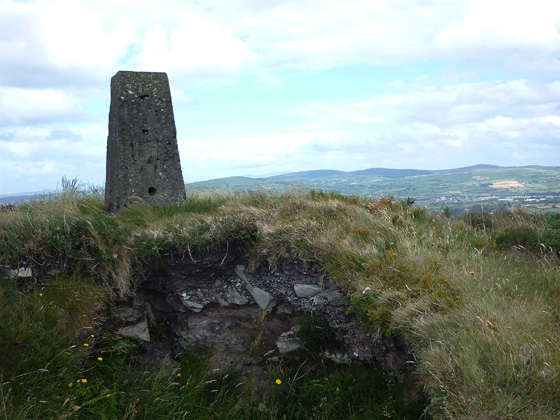
The stone structure on the top of the hill is called a Trigonometrical Point and is used for surveying.


The whole area surrounding Croaghan Hill is famous for its fishing, hill walking, music, dancing, friendly B&B's, home baking and open 'Donegal Gardens' where you can view the flora and fauna of Donegal.


Croaghan Hill overlooks the 'Land of Ithe' which overlooks other History Links Project hubs including Bready, Strabane, Douglas Bridge, Ardstraw, Castlederg and Newtownstewart in County Tyrone, as well as Castlefinn, Lifford, Raphoe and Manorcunningham in County Donegal.


These places with their rich cultural of farming, numerous historical sites, ancient churches, stone circles, standing stones, holy wells and mass rocks, a land of myths and legends all interwoven with six rivers; The Strule and Derg which unite to form the Mourne which in turn unites with the Finn, and the Deele, all which flow into the River Foyle. All surrounded by heather clad mountains, fertile valleys and turf bogs.


In terms of tourism in the future, from the top of Croaghan (which in the future could possibly be reached by monorail or lifts) or by walking the winding trail you could view the surrounding areas, perhaps with four telescopes pointing North, South, East and West. Visible from this point are the rivers the Mourne, Finn, Deele, Foyle and even Lough Swilly.

In a clear day you can see Barnesmore Gap and Grianan of Aileach. From here you could plan your itinerary with the help of the 'land of Ithe' exploratory leaflets and begin your journey into the past while enjoying the present.

Casltefinn - Leisure

The parochial hall in Castlefinn used to have an Irish dancing class on a Monday night. I went to that every week. The eight hand team won the All Ireland Féis Cheoil championship in the late 1960s. The record hop on a Saturday evening, it was just dancing to all the latest music like the Stones and the Beatles. They used to show films in the hall too. Every so often a western show would come where there was a cowboy and a horse. The cowboy was supposed to be some famous cowboy like Roy Rogers. He used to shoot his gun and balloons would pop at the same time! It was a big show.

We had a youth club in the hall too. Fr. Conway started the youth club. There used to be a talent show there too, run by the youth club, and Daniel O’ Donnell sang in the first one. They used to have sports in the hall like basketball, volleyball and netball. There was also table tennis. We used to go away and play the sports all across Tyrone. The youth club also started the first ever savings club. You used to collect money from houses and pay it back at Christmas, keeping the interest to fund the club. It was a great going thing at the time. It only ended two or three years ago.

The sports days were also big. You had sports days in Tievebrack, Clady and Castlefinn. They were always on a Sunday once a year. Football was a big thing, tug of war, egg and spoon races to fund the Parochial and the local clubs. Castlefinn and the Cross were always big rivals.

The Christmas Bazaar was in the Parochial hall. You had to donate stuff to the Bazaar first. There was turkeys, bags of potatoes and hampers. You bought a ticket then and you could go and buy all the stuff back. There used to be a rickety wheel with numbers and a pointer at the top and if your number came up you might have won anything from 2lb of sugar, a bag of spuds or even a hamper.

The G.A.A. club had fair days out in the Diamond. We had stalls and animals and foodstuffs. There would have been an auction at the end for the livestock and some of the goods. Farmers always donated livestock for the G.A.A.

The Castlefinn festival was on once a year in July. One year Jack Charlton came up to open the festival while he was managing the Irish Soccer Team. They tried to bring it back recently but it didn’t take off as well.

Participants:

Margo Mc Ghee

Sam Gallagher

Nettie Gillespie

Thursday, 10 March 2011

Lifford - Leisure

At Prior School, which I attended for a few years as well, boys and girls had to play hockey, whether we liked it or not. I was one of the ones who liked it. I can't say the same about cricket, I like watching cricket but not playing the game. We went all over Northern Ireland, Donegal and Sligo playing hockey, but we never went down the country. After I left school I joined Strabane Hockey Club and spent quite a few years playing there.

I must have been about twenty years old before I started playing tennis in Urney and then in Donaghmore. About the time I started the tennis I also started playing badminton, which I enjoyed very much in Donaghmore. Donaghmore had a church hall where they held socials. The Presbyterians did not allow dancing in their halls. You had the likes of The Siege of Venice and the Waves of Tory. If a dance would happen to start up the minister of the said church had a whistle and all you heard was a few blasts of the whistle to cool things down again.

Things have come a long way since the sixties, but I don't know if it's for the better or not. - Joe Mc Cormick


Growing up I didn't have much leisure time, after work when I got home I had to help out around the house, and help with my brothers and sisters, and at weekends I helped my dad with his book work, and orders for customers so I had a busy life. I did get to the cinema, and concerts when something good was on and I still enjoy the cinema regularly. - Carmel Parkes


I lived beside St. Pats hall and growing up I would watch all the local girls going into the dance. The glamour of the girls, in their pretty dresses, lovely hair style and nice high heels shoes. I just couldn't wait to be old enough to go dancing.

In the late 50s it was in St' Pat's that I learned to dance the 'Slow Waltz', 'Tango', 'Quick-Step', Old-Time Waltz' and 'Fox Trot'. The boys would stand at one side of the hall and girls at the other. When Tommy Mac's band started to play there was a rush of boys across the floor to ask a girl to dance. The dance consisted of three parts, and if the next dance was ladies choice she returned to that boy. Then if he came back to dance with her again and take her for a mineral chances were he would have asked to walk her home.

In the early 60's Rock and Roll became phenomenal with Elvis Presley singing 'Jail House Rock', 'Blue Suede Shoes' and Bill Haley singing 'Rock around the Clock' Cliff Richards singing 'Living Doll' and of course the Beatles.

Style of dress also changed to the can-can skirt and hair in a pony style and flat shoes were best for jiving in. Some boys wore Teddy Boys suits which were narrow leg trousers with a long jacket, thick soled shoes and a Tony Curtis hair style.

Television was another phenomenon bringing us news from around the world. 'Top of the Pops' was a great favourite. - Maureen Hegarty