Monday, 22 November 2010

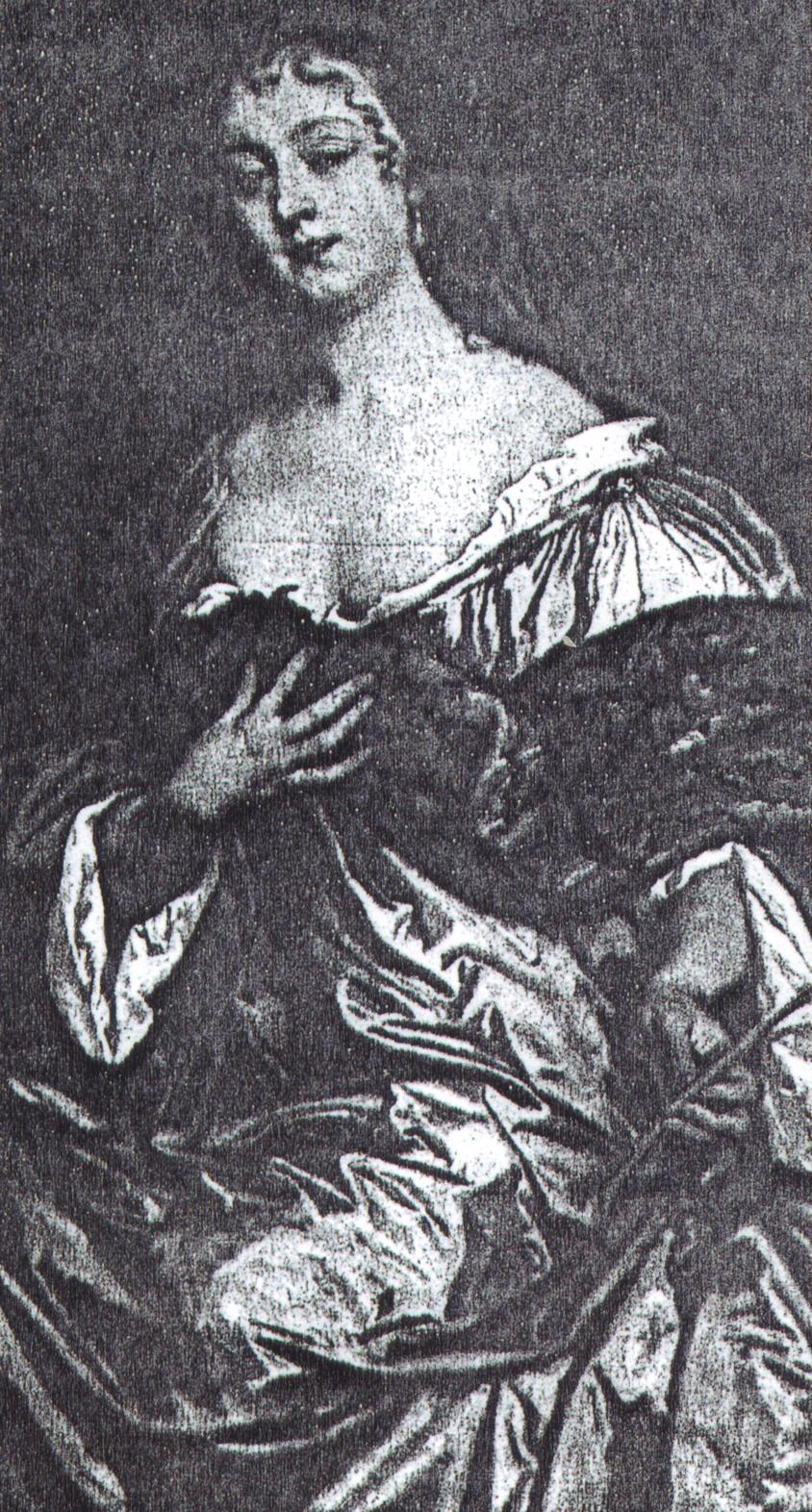
Lady Elizabeth Hamilton - Reene Donaghy


She was born at Mountcastle, eldest daughter of Sir George Hamilton, fourth son of the first Earl of Abercorn, and his wife Mary who was the daughter of Thomas Butler Viscount Thurles.

At the court of Charles II, Elizabeth was reported to be both beautiful and witty earning the title 'La Belle Hamilton'.

The court painter Lely painted her portrait many times and National Portrait Gallery online records nine images of her in its collection.

Popular with the king, she refused marriage to the Dukes of Redmond, Norfolk and Tyrconnell, but a eventually married the Comte de Philibert Gramont in 1662 apparently after he was put under pressure by her two brothers. He had been exiled to the London Court by Louis XIV for paying too much attention to one of the king's mistresses.

After marriage, Elizabeth went to Paris where she became Dame du Palais to Queen Maria Theresa of France.

Elizabeth had two daughters, Claude Charlotte who married the Earl of Stafford and Marie Elizabeth she became Abbess of Sainte Marie de Puissey in Lorraine.

St. Patricks Well - Magherakeel by Sara Moss


Situated approximately two miles form the village of Killeter is St. Patrick's Well, Magherakeel in the parish of Aghyaran (Termonamongan) Co. Tyrone. The parish has three holy wells; St. Patick's Well (Tober Phadraig), St. Davog's in Croighdenis and Fr. Mc Louighlins Meenard in Slievedoo.

The most popular and well known of these is St. Patricks well in Magherakeel. Some people think these wells were blessed by early saints and therefore continued to be a place of devotion. This well was blessed by St. Patrick himself and legend has it that he stopped here to rest and quench his thirst on his way from Lenten Sacrifice in Lough Derg.

On the 17th March every year bands parade to the well before rosary is recited at 3pm to a large crowd of people. This is a very important date in the parish calendar. Throughout the year people make visits here in search for cures and holy water for the sick. It is very well maintained and a 'must see' for those that have not yet paid it a visit.

Elements of History

Writing about St. Patricks Well can take in different elements of history, Religious, Architectural and Social. With the religious element it is a place visited by St. Patrick himself, and has an annual gathering on 17th March for the rosary as well as daily visits by people looking for cures and have great beliefs that their sickness or disease can be cured or relieved for whatever length of time.

The Architectural structure of the well has been carried out many, many years ago but in recent times has had a rebuild to give it a more modern look. Railings have been replaced by a stone built wall as well as the statue being erected into the stone wall, the well itself has a stone arch over it opposed to the open design. This would be for safety reasons and to keep the water clean. It still plays a big part in the social life for local people, as on a regular basis people call and get a great sense of quietness and calm to reflect on their faith and pray for whatever reason.

Sunday, 21 November 2010

Political History - Countess Markievicz by Maureen Hegarty


Constance Gore-Booth was born in London in 1868. Her father was Sir Henry Gore-Booth, the famous arctic explorer. He was also a kind Anglo-Irish landlord. During the famine year of 1879 Constance was living in Lissadell House in Sligo, Ireland.

In 1893 she went to London to study painting, also joining the 'National Union of Women's suffrage'. Constance met Count Markievicz of Polish origin in 1898. They married in 1901. Returning to live in Dublin in 1903, she co-founded the 'United Artists Club'.

In 1908 she joined Sinn Féin and the 'Daughters of Ireland' and in the same year also helped defeat Winston Churchill in a Manchester by-election.

In 1909 Constance set up 'Fianna Éireann'. It's aim was to instruct the youth army in the use of firearms.

She was jailed in 1913 for speaking out at a rally in protest of George Vs visit to Dublin. The same year she joined James Connolly who had set up the 'Irish Citizens Army' in protest against the lock out of workers. Her marriage also ended this year with her husband returning to Europe.

For six days she was second in command at Stephen's Green during the 1916 rising. She was sentenced to death, but pardoned because she was a woman. She was put in Kilmainham jail for life where she told them 'I do wish your lot had the decency to shoot me.' While in jail she was elected to Sinn Féin in 1917 after the government granted amnesty to her.

In 1918 she was jailed again but with 92 other women on hunger strike. They were released due to embarrassment to the Irish and British governments. Upon her release she was elected to the English parliament but refused to take her seat. She was the first woman to be elected to the House of Commons.

Constance became a Labour Minister in 1919 serving in the first Dáil. In 1922 she joined De Valera in opposition to the Anglo-Irish treaty. Again she was imprisoned, but this time by her former comrades in arms.

In 1926 she became a member of Fianna Fáil and was elected to the Dáil but she died on the 15th July aged 59, five weeks before she was due to take her seat in the Dáil.

During her life time in Dublin she had compassion for the poor setting up soup kitchens and visiting slums. It is thought she may have caught Tuberculosis while doing this. It is also thought her compassion was inherited from her father, who had showed kindness to the poor during famine years.

W.B. Yeats (her friend in Sligo) wrote a poem entitled 'In memory of Eva Gore-Booth and Constance Markievicz. 25,000 people lined the streets as her cortege was driven to Glasnevin cemetary. She had one daughter who was reared with the Markievicz grandparents. Her religion was Church of Ireland.
Whats changed in Lifford by Patricia Mc Granaghan (H.E. assignment)


A lot of changes have occurred in Lifford. It's not the same wee town.

There's a bypass now since the 1960s or early 70s. Before that we used the road to get to the town but the big lorries couldn't get around (without difficulty). Harte's corner - you can imagine without the bypass what it would be like!

There were two factories making shirts, and a coach factory that also made coffins, and coal and grain yard. There was an egg factory called the Elm Bank but then it became sort of a parish hall where a lot of things took place. We had a youth club there, now its gone and on the site is an A.I.B bank.

There was a train station and as wains we used to go down the fields and wait for the train to go past. The driver used to sound the hooter at us and we were very happy.

There's now a state of the art cinema with several screens, but I yearn for the old picture house with the one screen. The Inter County Hotel is gone and now we don't have a hotel.

Wains - children

Technology by Joe Mc Cormick (H.E. assignment)

Technology came to England in the 18th century in the form of the industrial revolution meaning a rapid change of life. It did not meet the approval of everyone, especially the working class. The Luddlites as they were known went round the country smashing every machine they could get their hands on, but eventually they had to accept the fact that times were changing.

Technology also had a great influence in the culture of the people in the Lifford area in the form of Railways. The first train left Strabane in the late 1800s and travelled to Bundoran and the one from Lifford started in the early 1900s and went to Letterkenny. For the first time the local population were able to travel to places they had only heard about.
There were also steam powered boats which came up the Foyle as far as Lifford and then entered the River Finn and up to Castlefinn with their cargos from the Derry docks.

The motor car was also conceived in the late 1800s or early 1900s, but only the elite were able to afford them until the middle of the present century. It was then that my late father bought one. He bought a Vauxhall 10 belonging to the late Dr. Coyne of Lifford. I still remember the registration number, it was IH 6063. There were so few cars on the roads then, and everyone knew the Doctors car, so when anyone met the car my father got a big wave from people he did not know from Adam!

The motor car surpassed the trains as a means of transport regarding social life, there were no restrictions on being there at a certain time and one might have some distance from the station to ones destination. In time the cars got more plentiful and it was not uncommon to see three or four cars parked outside the average house. There would have been very few ballrooms built in the sixties in Co. Donegal had it not been for the humble car.

Before I finish I have to write a few words on computers, with the likes of Twitter and Facebook, folk are making friends all over the world. I wonder where it is going to end.

All I can say is that there is a distinct relationship between technology and culture. Look at all the seaside towns with all the hotels and places of amusements which sprung up with the advent of the railways coming to their towns. The likes of Bundoran and Buncrana would not be what they are today had it not been for the railways coming to their towns. Regarding the motor car, young people had no means of transport until the availability of the car, they usually did not travel more than five miles from their place of birth, they more than likely took a mate from that small area, usually within walking distance, but now distance is no object. A young chap could travel fifty miles per week to meet with his beloved. Where would we be without technology?

Austraila's first and only Republic by Bob Kavanagh (H.E. Assignment)


In 1851 gold was discovered in the area of Mount Bonan Yowing in Victoria, Australia. The discovery led to the founding of the town of Ballarat, whose population grew rapidly from 1000 a month after the discovery to over 20,000 two years later.

The authorities in Melbourne imposed a license on miners, who were constantly raided by police. Those without a license were brought to court, where they were fined and jailed. By 1854 miners became more and more disgruntled with the authorities, and their meeting and pleadings went unheeded.

Eventually they planned opposition to the police raids and elected one Peter Lalor to organise the miners. Peter lalor was the brother of James Fintan Lalor, the renowned Irish socialist reformer from County Laois.

Expecting more police raids, they began erecting barricades on Bakery Hill, Ballarat. One Mary McCloud made a blue flag from her wedding dress, on which she stitched five white stars in the shape of the stars of the Southern Cross.

Mary McCloud was to be married to Patrick Shanahan, a miner and one of the leaders chosen by Peter Lalor. The wedding was to have taken place on Sunday the 3rd of December 1854, so barricades were erected on Saturday 2nd and the flag was raised. The miners then declared the 'Republic of the Southern Cross.'

On Sunday 3rd December 1854 over 300 soldiers and police arrived at the barricades where a number of miners and police were shot and killed. Amongst the dead was Patrick Shanahan.

The miners eventually surrendered to the soldiers rather than the police whose brutality and random slaughter the miners feared. The miners stand and the battle went down in history as the battle of the Eureka Stockade.

The Eureka stockade story is principally a social history, because it led to better conditions and more rights for the miners. It was also the first blow struck for more democracy in British ruled Australia. Many of the leaders of the rebellion were Irish who had been deported of left Ireland to escape hunger and deprivation at home, and many of whom wished to escape from British domination.

Christianity by Margaret Giblin (H.E. assignment)


Christianity began over 2000 years ago with the birth, life, death and resurrection of Jesus, the son of God. It was based on the Bible, the Word of God and through the years the Apostles and Disciples, with the aid of the Holy Spirit and the written word, spread it all over the world.

Through the years with the advancement of technology, other instruments became available for writing, for example ink pens, biros, typewriters, computers and nowadays there is the possibility of the Bible being available as an E-book on the internet.

Christianity in Ireland began with the arrival of St. Patrick in the second half of the 5th century and this changed the social and political life of the Irish people. The practice of Christianity brought hope to the people but through the years with the invasion of foreign rulers and with the advent of different political and religious divisions, many Christians from all churches were persecuted and had to go into hiding.

The church at Murlog was named after St. Patrick for according to the tradition, in the 5th century as he was traveling from Ballyshannon to Lough Derg to bless the people his cart broke down at the ford in Ballindrait. When it was refused he is said to have cursed both areas and said they would never grow into cities.

Elements of History

The use of the various instruments used for writing the Bible denotes how technological knowledge advanced through the centuries.

The spread of Christianity has changed in Ireland with the demise of the house stations, parish missions and other religious celebrations, which brought families and neighbors together.

Today Christianity is just a faint shadow of the teachings of St. Patrick. The majority of people today still attend church only for baptisms, weddings and funerals. A minority of people still hold on to the true faith preached by St. Patrick.